How to use DecisionVault with Zapier
Connect DecisionVault with Zapier and start automating workflows.
Check our Official Zapier Integration in Zapier: https://zapier.com/apps/decisionvault/integrations
Authenticating
-
In DecisionVault, go to Settings > Integrations. Under Workflow Automation, the Zapier card has a DecisionVault Zapier App button that takes you to our listing on Zapier.
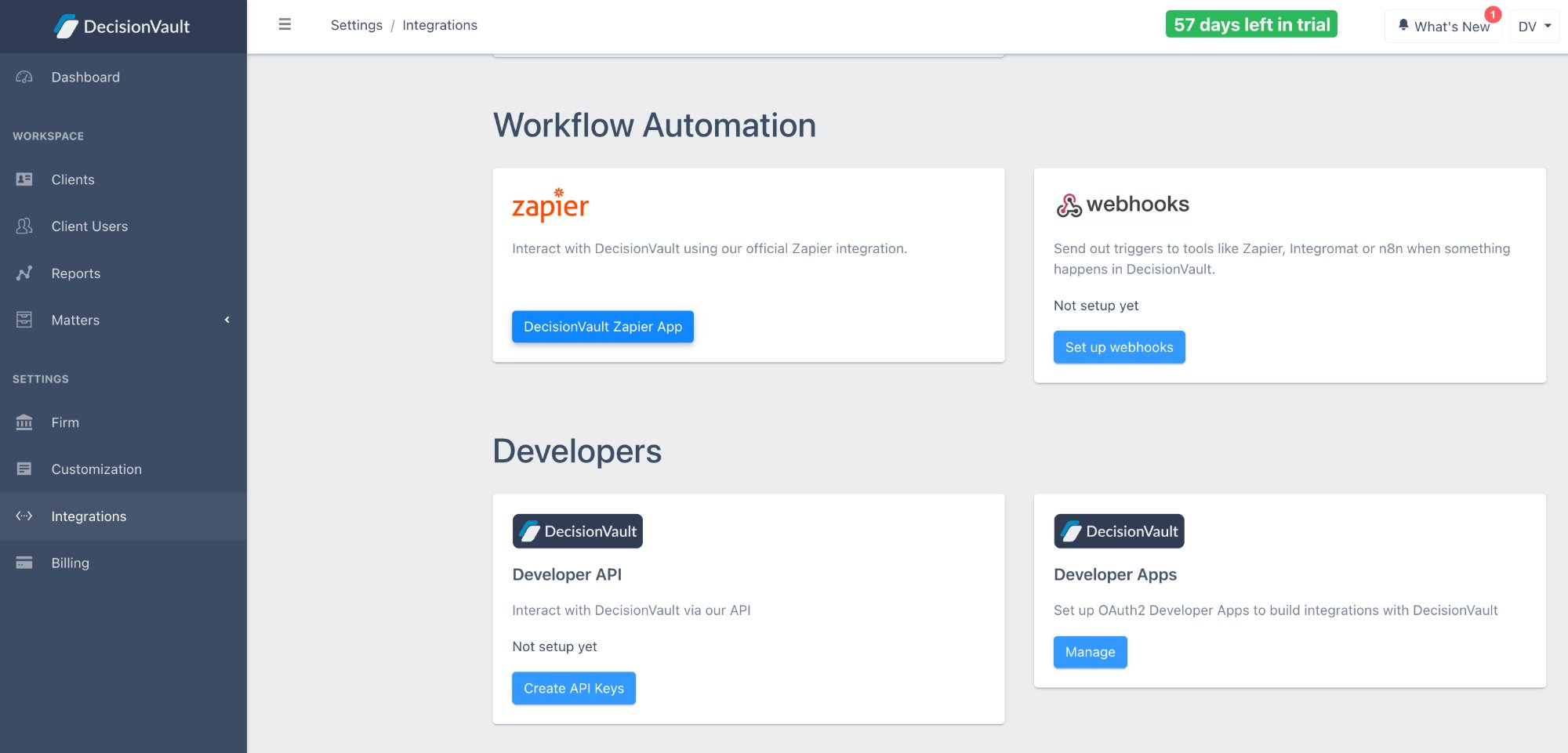
-
Add DecisionVault as a step in a Zap. When Zapier asks you to connect an account, a DecisionVault window opens headed Authorize Zapier.
- Choose Allow Access. Granting access lets Zapier read the information on your matters.

- You will see a Connected confirmation with your firm's connection listed. You can close that tab and carry on building your Zap.
Note: You must be signed in to DecisionVault in the same browser for the authorization screen to recognise you.
Triggers
New Event: Triggers when there is a new event.
This is an instant trigger: DecisionVault notifies Zapier as soon as the event happens, so your Zap runs right away rather than on a polling schedule. When you add the trigger you pick a single Event Type. If you want to act on more than one event, build one Zap per event.
These are the current events available:
| Action Name | Event ID | Description |
|---|---|---|
| Intake Created | intakeform.created | The firm creates the matter and chooses the type of questionnaire. This fires whether or not a client is ever invited . |
| Intake Started | intakeform.started | The client creates an account and begins filling out the intake form. |
| Intake Submitted | intakeform.submitted | The intake form is submitted for the first time. |
| Intake Resubmitted | intakeform.resubmitted | The intake form is submitted again after updates. |
| Intake Completed | intakeform.completed | The intake form is marked as complete by the firm. |
| Meeting Template Completed | meetingtemplate.completed | The meeting template (design sheet) is marked as complete. |
Actions
DecisionVault provides several actions you can use within your Zaps:
| Action Name | Type | Description | Common Use Cases |
|---|---|---|---|
| PreCreate Matter | Write | Creates a new matter and returns an invite link for the client. You send the link yourself. | Automatically send intake links from a CRM or website form |
| Create Matter and Invite | Write | Creates a new matter and emails the invite directly to up to two clients. Each invite comes back marked either invited or failed. | Onboard a couple straight from a signed engagement letter, with no link to copy |
| Get Matter | Search | Retrieve details for a specific matter by ID. | Sync matter data into CRM or reporting tools |
| Get Contacts for Matter | Search | Pull all contacts associated with a matter. | Create/update contacts in CRM systems |
| Get Roles for Matter | Search | Pull all roles for a matter and who is assigned to each. Returns one record containing every role. | Push fiduciary appointments into drafting software or a matter checklist |
| Get Answers for Matter | Search | Pull every questionnaire answer for a matter, including questions the client left blank. Returns one record containing every page and question. | Feed intake answers into document automation or a review sheet |
| Get Assets for Matter | Search | Retrieve all assets tied to a specific matter. | Sync financial/asset data into external systems |
| Get Documents for Matter | Search | Retrieve all uploaded documents for a matter. | Store or process documents in a DMS (Dropbox, Google Drive, etc.) |
| Get Financial Documents for Matter | Search | Retrieve financial documents submitted through the financial intake. You can optionally limit results with Uploaded Since. | Trigger financial review workflows |
| Get Document | Search | Retrieve details for a specific document by ID. | Pull individual document data for automation |
| Get User | Search | Retrieve user details by ID. | Get client user information. |
PreCreate Matter or Create Matter and Invite?
Both create the matter. The difference is who sends the invitation.
- PreCreate Matter hands the invite link back to your Zap. Use it when you want the link to go out from your own CRM, your own email template, or a text message.
- Create Matter and Invite has DecisionVault email the invitation for you, to one or two clients. Use it when you want the standard firm-branded invitation with nothing else to configure.
Testing Create Matter and Invite: Unlike PreCreate Matter, this action emails your clients as soon as it runs including when you test the step while building the Zap. Testing creates a real matter and sends real invitations. Use your own email address in the Client 1 Email field while you are setting the Zap up, and swap in the live data only once it works.
Frequently Asked Questions
What are some example Zaps law firms use?
A few popular patterns:
- A signed engagement letter in DocuSign triggers Create Matter and Invite, so the client receives their intake invitation automatically.
- A new lead form on your website triggers PreCreate Matter, and your own branded email or text message sends the invite link.
- The Intakeform Submitted event posts a message in your team's Slack or Teams channel, so everyone knows the intake is in.
- The Intakeform Submitted event runs Get Answers for Matter and feeds the answers into your document automation tool or a review sheet.
- The Meeting Template Completed event creates a drafting task in your practice management tool.
- The Intakeform Created event adds a row to a Google Sheet so you can track every new intake.
- Get Documents for Matter saves client uploads into Dropbox or Google Drive.
Do I need the webhooks integration to use Zapier?
No. The DecisionVault Zapier app connects directly, and its New Event trigger is instant. The separate webhooks integration is for other automation tools like Make and n8n, or for custom endpoints your team builds.