How to set up the integration between Clio and DecisionVault?
Setting up the integration involves the following steps:
- Set up Custom Fields in Clio
- Authenticate Clio with DecisionVault
- Map the Custom Fields to DecisionVault Fields
- Sync a Matter and Contacts to Clio
1. Set up Custom Fields in Clio
There are several standard DecisionVault fields that can sync to Clio by default:
| DecisionVault Field | Clio Field |
|---|---|
| Contact - First Name | Contact - First Name |
| Contact - Middle Name | Contact - Middle Name |
| Contact - Last Name | Contact - Last Name |
| Contact - Date of Birth | Contact - Date of Birth |
| All contact detail fields (addresses, phone, email). | All contact detail fields (addresses, phone, email). |
To sync additional information over (such as the Date of Death, Gender, etc.) you'll have to create custom fields in Clio to receive this info from DecisionVault. You can do this in Clio under Settings > Custom Fields here.
The correct settings for these fields are:
Contact - Also Known As:
- Contact Custom Field
- Type: Text (One-Line)
Contact - Preferred Name:
- Contact Custom Field
- Type: Text (One-Line)
Contact - Gender (Binary):
- Contact Custom Field
- Type: Picklist
- Options: Male, Female
Note: In the DecisionVault questionnaires you have the option to include "Non-listed, specify ____" as a gender option. When it's time to sync to other tools the app will ask the attorney user to put in a binary choice, because several of the integrations require it.
Contact - Date of Death:
- Contact Custom Field
- Type: Date
Contact - Social Security Number:
- Contact Custom Field
- Type: Text (One-Line)
Contact - Status (living or deceased):
- Contact Custom Field
- Type: Picklist
- Options: Living, Deceased, Incapacitated
Contact - United States Citizen:
- Contact Custom Field
- Type: Picklist
- Options: Unknown, United States Citizen, Not United States Citizen
Contact - United States Resident:
- Contact Custom Field
- Type: Text (One-Line)
- this will show up as "Yes" or " " (blank)
2. Authenticate Clio with DecisionVault
To authenticate Clio with DecisionVault go to the Integrations page - and look for the "Authenticate with Clio" button. Follow the prompts to login to Clio and to give DecisionVault access.

Note: This only stores an 'access token' in DecisionVault to access Clio on your behalf. We don't have access to your login details, and you can always remove DecisionVault's access in Clio under App Integrations > My Integrations.
3. Map the Custom Fields to DecisionVault Fields
After authenticating with Clio you will get redirected automatically to the Custom Fields mapping setup page:

This lists the DecisionVault field on the left, and the available custom fields that were found in your Clio account (that haven't been mapped yet) on the right hand side -- available to map them.

You are now also able to Map Matter fields in the questionnaire with Clio custom fields. Below you can see how the custom fields are reflected in Clio.

Some specific guidance on lining up the field types: a Yes or No question in DecisionVault maps to a Checkbox custom field in Clio.
4. Sync a Matter and Contacts to Clio
After you map the custom fields, when you open up a matter detail screen on the attorney side of DecisionVault you can click 'Integrations" on the right hand side and then Clio.

For a matter that has not yet been synced with Clio - DecisionVault will first give you the option to link the matter to an existing one in Clio, by searching in your matters. Or you have the option to just let DecisionVault create a new matter in Clio.

If you want to link an existing matter, type in the matter name in the search box and then click "Link to this matter"

After this - you get to the sync screen where you can link the existing matter and contact in Clio. You can also choose if you want to rename the DV matter to match the name from Clio. After linking the matter and contact click "Link Matter and Contacts".

After linking the matter and client contact, you will be able to select which other contacts you want to sync over to Clio. You are able to update existing contacts or create new ones. After selecting the contacts click "Start Sync".

After the sync is complete, you can review the sync'd contacts and matter in Clio by clicking the provided link.

5. Choose which documents upload to Clio
The sync can also upload documents from DecisionVault to the linked Clio matter. Go to Settings > Integrations > Clio and click Edit on the settings panel. This is the same panel where you set the US State format for addresses, with a choice of Full State Name (for example Colorado) or State Code (for example CO):

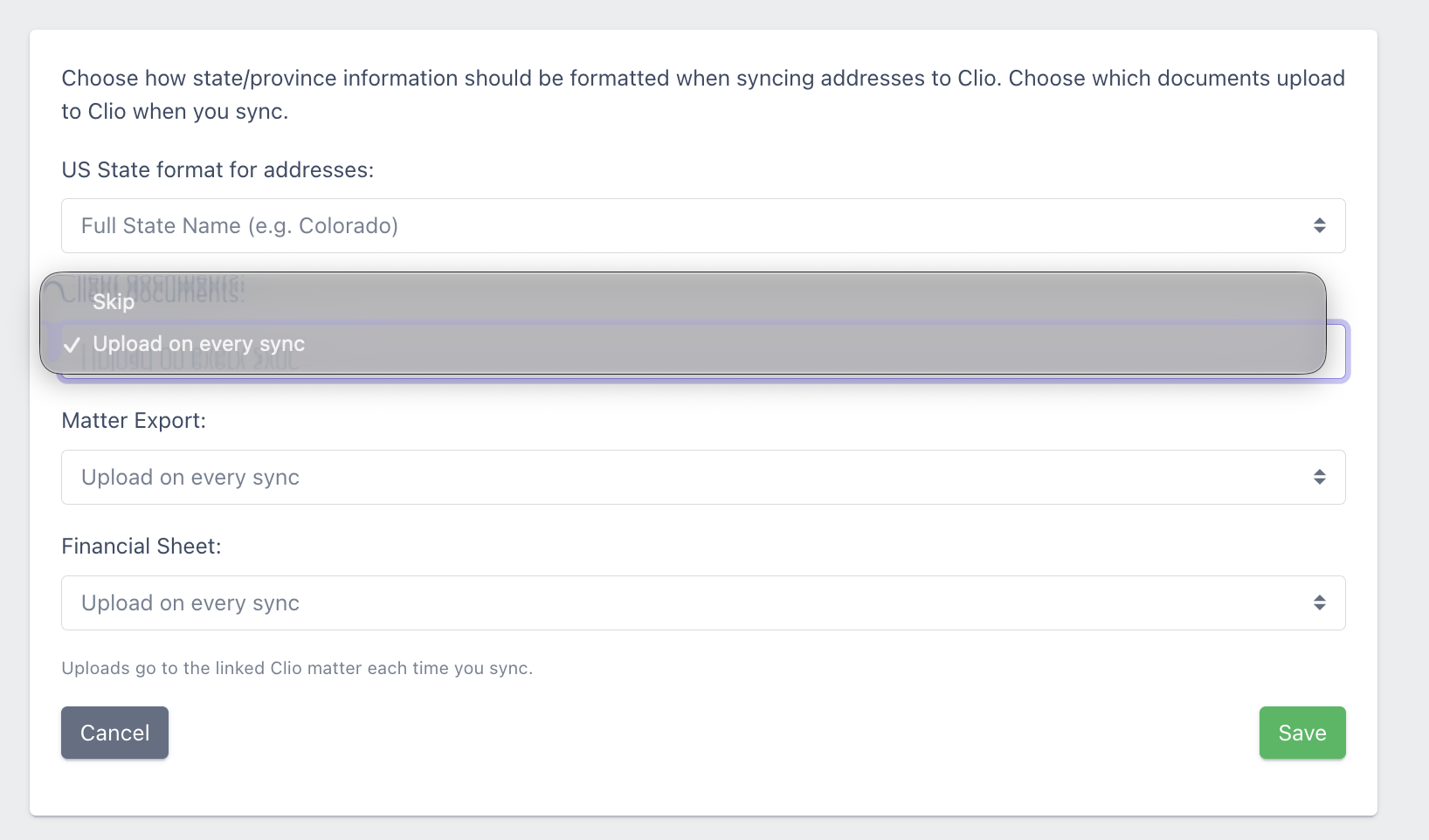
You can choose three types of uploads. Each one is set to Skip by default:
- Client documents: the files uploaded to the matter in DecisionVault. Each client document uploads once.
- Matter Export: each sync uploads a new copy and removes the previous one when possible.
- Financial Sheet: each sync uploads a new copy and removes the previous one when possible.
Set a dropdown to Upload on every sync to include that type of document, then click Save. The documents then upload to the linked Clio matter each time you run a sync.
Frequently Asked Questions
Which fields sync to Clio without any setup?
First, middle, and last name, date of birth, and all contact detail fields such as addresses, phone numbers, and email addresses. Everything else needs a custom field in Clio and a mapping in DecisionVault.
Why does a custom field not show up on the mapping page?
The mapping page only lists custom fields that exist in your Clio account and are not mapped yet. Create the field in Clio first under Settings > Custom Fields, with the type shown in step 1, then return to the mapping page.
Does DecisionVault store my Clio password?
No. Authenticating only stores an access token so DecisionVault can reach Clio on your behalf. You can revoke it at any time in Clio under App Integrations > My Integrations.
What happens if the client chose a non-listed gender option?
When you sync, the app asks the attorney user to pick a binary choice, because several of the integrations require it. The client's original answer stays unchanged in DecisionVault.
Do documents upload to Clio during the sync?
Only if you turn it on. Go to Settings > Integrations > Clio and set Client documents, Matter Export, or Financial Sheet to Upload on every sync. All three are set to Skip by default.
Can I control how US states appear in the addresses synced to Clio?
Yes. Go to Settings > Integrations > Clio and click Edit on the settings panel. The US State format for addresses dropdown controls how the state is written when DecisionVault syncs addresses to Clio: Full State Name (for example Colorado) or State Code (for example CO). Pick the format that matches how your firm stores addresses in Clio, then click Save.