How to set up the integration between Gavel and DecisionVault (from start to finish)
The below video shows in full detail how to set up the workflow and documents in Gavel, and how to link that to DecisionVault for input.
It goes over how to:
- Build up your Gavel workflow
- Map the fields into a MS Word Document
- Set up the repeating item fields on the DecisionVault side
- Push information gathered from clients in DecisionVault over to Gavel
DecisionVault supports pushing information into regular variables in the Gavel workflow, and can also push any number of contacts and financial items into Gavel's "repeating item" fields.
1 - Build up your Gavel workflow
You can build up a set of pages with variables in the Gavel workflow to receive the information that DecisionVault will push:

2 - Map the fields into a MS Word Document
You can then use these variables to fill in a Word document (or PDF):

3 - Set up the repeating item fields on the DecisionVault side
Before DecisionVault can push anything into a repeating item, you need to tell it what that repeating item represents and which fields feed it. You do this under Settings > Integrations > Gavel then clicking on Settings.

Choose your workflow under Select workflow and click Pull Workflow Info. DecisionVault reads the workflow and lists every repeatable object it found, each in its own card.

Choose what the repeating item represents
Each repeating item has an Object Type. You have two choices:
- Contacts: the repeating item is a list of people. Map its attributes to DecisionVault contact fields.
- Financial Items: the repeating item is a list of assets, liabilities, income or expenses. Map its attributes to fields on the financial items your client entered in the questionnaire.
The attributes you can map depend on which one you pick, so choose the object type first.
Map the attributes
Click Edit on any row to choose the DecisionVault field that fills it, then Save. Clear removes a mapping, and anything you haven't mapped yet shows as -- not mapped --. You don't have to map every attribute and unmapped ones are simply left out.
Start Over clears every object type and mapping for the workflow and returns you to workflow selection.
For a Contacts object you'll see the contact fields:

Fields available for Contacts
| Name | Full Name · First Name · Middle Name · Last Name (incl. suffix) · Also Known As · Preferred Name |
| Personal | Gender · Date of Birth · Date of Death · Age · Social Security Number |
| Relationship | Relationship · Related to 'who' |
| Address | Address - Full · Street · City · State · Zip · County · Country |
| Contact | Phone · Email |
For a Financial Item object you'll see the financial fields:

Fields available for Financial Items
| Field | What it contains |
|---|---|
| Financial - Category | The financial category the item sits in |
| Financial - Subcategory | The subcategory, e.g. Real Estate or Bank Accounts |
| Financial - Item Name | The item's name |
| Financial - Item Label | The label shown for the item in DecisionVault |
| Financial - Value | What the item is worth |
| Financial - Loan / Debt | Any loan or debt against the item |
| Financial - Net Value | Value minus loan or debt, calculated for you |
| Financial - Owner | Who owns the item |
| Financial - Beneficiaries | Any beneficiaries recorded on the item |
Matter fields
Matter - Name and Matter - Open Date are available for both object types.

4 - Push information gathered from clients in DecisionVault over to Gavel
To push information you must open the matter details screen and go to Integrations > Gavel.

Then choose your workflow under Select workflow, and click Pull Fields. Every variable in the workflow appears under

Mapping the regular fields
Start with the Type of info dropdown:
- None (clear mapping): send nothing for this variable, and remove any mapping already set. The remaining dropdowns grey out.
- Matter Info: Marital Status and Date of Marriage.
- Two options, each with a choice of format:
- Marital Status: send it in full (Married) or as a shortcode (Shortcode | Married ( M )), depending on what your template expects.
- Date of Marriage (main couple on matter).
- Specific Person: Client or Client's Spouse.
- Contact: any individual contact on the matter, chosen by name.
- Role: whoever holds a particular role, chosen by role and position.
These three all end up at the same place: a person, and one detail about them, but they differ in how you identify that person:
- Specific Person identifies them by their position on the matter: Client | John Adam Smith or Client's Spouse | Sally Smith.
- Contact lists everyone on the matter by name, so you can reach a contact who isn't the client or spouse.
- Role lists every role assignment as role – position – name, for example Trustee - 1 - Sally Smith or Successor Trustee - 1 - Simon Smith. Roles you've split between clients show whose role it is (Long-term Guardian - John - 1, Long-term Guardian - Sally - 1), and co-roles at the same position appear as 2a and 2b.
Once you've picked the person, the last dropdown offers their details, with the current value shown in brackets so you can confirm you've got the right one.
| Type of Contact Detail | Options available |
|---|---|
| Name | First Name · Middle Name · Last Name · Full Name · Prior / Other Names · Preferred / Nickname |
| Personal | Relationship · Gender · Date of Birth · Age · US Citizen? |
| Contact | Phone 1 - Mobile · Email 1 - Home |
| Address | Addr1 - Home - Street · City · State · State (2-letter) · ZIP · County · Country · Country (3-letter) · Full US Short |
- Question/Answer: an answer captured in DecisionVault.
- Reaches every answer captured both in the questions on your questionnaire and the questions on your meeting templates. Questions are listed as Section | Question, for example About You | Are you planning separately?, and the last dropdown shows the client's current answer.
- If the client hasn't answered yet, you'll see (Not answered yet). The mapping still saves; the variable simply arrives empty until they answer.
There is one exception: answers given in a template text component on a meeting template can't be pushed to Gavel yet. Everything else on the meeting template is available.
Choosing which contact type repeating items to send
For a repeating item mapped to Contacts, you have five options:
- Client(s): the client and spouse (if married) on the matter.
- Children: the children recorded on the matter.
- Group of People Component: the people your client grouped together in a people group box on the questionnaire.
- Role Assignment: the contacts you've assigned to a role on the matter, in the order you set.
- Selection of Contacts: pick contacts yourself, one at a time.

Use Role Assignment when the document needs people in a specific order (successor trustees, for example, where first and second matter). Use Group of People Component when you want everyone your client named for a role without ordering them yet.
Choosing which financial type repeatable items to send
A repeating item set to Financial Items shows a Financial Items badge and a source dropdown. Pick how you want to fill it:
- All Financial Items: everything on the matter.
- Assets & Liabilities: all of them, or narrow to one subcategory such as Real Estate, Bank Accounts, or Vehicles.
- Income & Expense: all of them, or just Income, or just Expense.
-
Selection of Financial Items: pick items one at a time. Choose an item and click Add; it appears as a card you can remove with X.
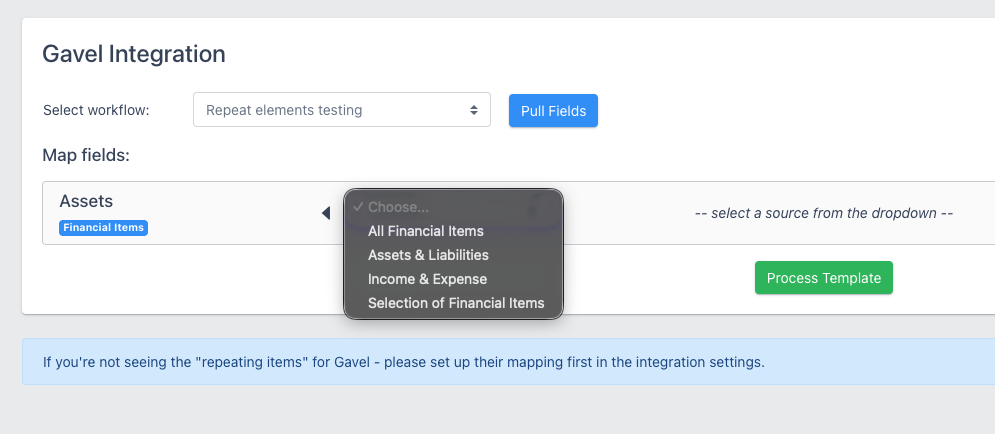
With the first three options the list is filled in for you and shown read-only, so you can see exactly what will be sent before you generate. Only Selection of Financial Items lets you add and remove individually. This is useful when one matter drives several documents and each needs a different slice of the inventory, sending only real property to a deed, for example, and only accounts to a funding letter.
Once every variable is mapped, generate the document from the matter as usual. DecisionVault sends the values you see previewed on the mapping screen, so what's shown there is what lands in Gavel.